Hello Kitty: Good Night
- 4.8
- Rating
- 5.00M
- Installs
- Free
- Price

 Analysis by App-foxy
Bedtime apps often struggle with a simple problem: they want to be calming, but they still need to give children something meaningful to do. Hello Kitty: Good Night takes a gentler route. It is an educational game from Hippo Kids Games built around helping Hello Kitty settle down for sleep while sharing bedtime stories with children and her family. After spending time with it, I see it less as a conventional game and more as a quiet evening activity with light interaction.
That distinction matters. This is not the kind of title I would open when a child wants fast challenges, competition, or a long adventure. Its appeal comes from the way its familiar character, soft setting, and unhurried tasks work together. The game is free to download, aimed at Everyone, and has reached more than five million installs. Those details make it easy to try, but the real question is whether it fits your family's bedtime routine.
A gentle first impression that understands its audience
My first impression was that the game knows exactly when it is supposed to be played. The central idea is not merely “Hello Kitty appears in a children's game.” The whole experience is shaped around the transition from daytime activity to nighttime calm. Instead of pushing the player toward constant progress, it gives the child a familiar character to care for and a peaceful situation to follow.
You May Also Like

 Blood Strike: 2.5 Anniversary
Blood Strike’s Loadouts Turn Every Drop Into a Tactical Gamble
A close look at Blood Strike’s custom loadouts: how fast access to signature weapons reshapes its battle royale rhythm, rewards preparation, and narrows the gap between fights.

 Pandora - Music & Podcasts
Pandora’s Music Is Easy to Start, but Harder to Recover
Pandora’s strength is its low-effort path from a seed to a station. Its weak spot is how much confidence it asks you to place in connection, setup, and quiet recovery.

 8 Ball Pool
 Is Built on Rivalries, Rematches, and Routine
A close look at the rivalries, rematches, shared routines, and unanswered safety questions that turn a quick pool match into a persistent mobile community.

 Samsung Music
’s Quiet Strength Is Playing What You Already Own
Its reach comes less from spectacle than from dependable access to a personal library. That simplicity is both the app’s strongest retention engine and its ceiling.

 AccuWeather: Weather Radar
AccuWeather Review: A Quick, Clear Forecast for Everyday Decisions
For everyday plans, the best forecast is the one you can understand quickly. AccuWeather makes rain timing, radar, and local conditions easy to act on, with a few trade-offs.

 Hill Climb Racing
Why Hill Climb Racing Still Turns Crashes Into One More Run
A tiny car, a bumpy hill and one more upgrade: Hill Climb Racing keeps resurfacing because its simple chaos makes every near-miss feel personal.
More From Our News Desk



That makes the opening feel approachable for younger players. A child does not need to understand a complicated story, learn a large collection of controls, or remember a detailed objective. The purpose is immediately readable: help Hello Kitty get ready for bed and enjoy stories together. I found that clarity useful because it reduces the amount of explanation an adult has to provide before handing over the device.
The game also benefits from choosing a well-known character as its emotional anchor. Hello Kitty's presence gives the activity a friendly focus, while the family-oriented setting keeps the tone warm rather than dramatic. The result is an experience that feels suitable for a child who wants company during the bedtime wind-down, not another source of stimulation.
Still, “calm” does not automatically mean “right for every child.” Some children will find the pace comforting, while others may quickly ask for more movement or more difficult goals. I would introduce it to children who enjoy pretend play, stories, and repeated routines. I would skip it for a child who expects an educational game to teach through quizzes, puzzles, or clearly measurable challenges.
The public response is encouraging, with an average rating of 4.8 from roughly 9.6 thousand ratings and 276 written reviews. I do not treat a rating as proof that every family will enjoy the same experience, but it does fit my impression that the game's narrow purpose is one of its strengths. It is not trying to be everything at once.
What a normal evening with the game looks like
A realistic use case is a child who has already put on pajamas but is not quite ready to put the tablet away. Instead of opening a loud arcade game, a parent can use this title as a short bridge between active play and a story or a goodnight routine. The child helps with Hello Kitty's bedtime context, follows the story-oriented activity, and then the adult can end the session without having to interrupt an elaborate mission.
I recommend setting expectations before starting. Tell the child that this is a bedtime activity rather than an unlimited play session. That small framing choice makes the game work better, because its slower rhythm becomes part of the routine instead of feeling like a limitation. If the child is already overtired, even a gentle game may prolong screen time, so I would use it earlier in the wind-down rather than at the exact moment lights should go out.
Another useful approach is to play alongside a young child during the first session. The adult can turn the story moments into a conversation about what happens before sleep, who is in the family setting, and why a quiet routine helps. This gives the game more value than simply leaving a child alone with it. The title supplies a setting for interaction; the parent supplies the personal connection.
How the visual world communicates bedtime
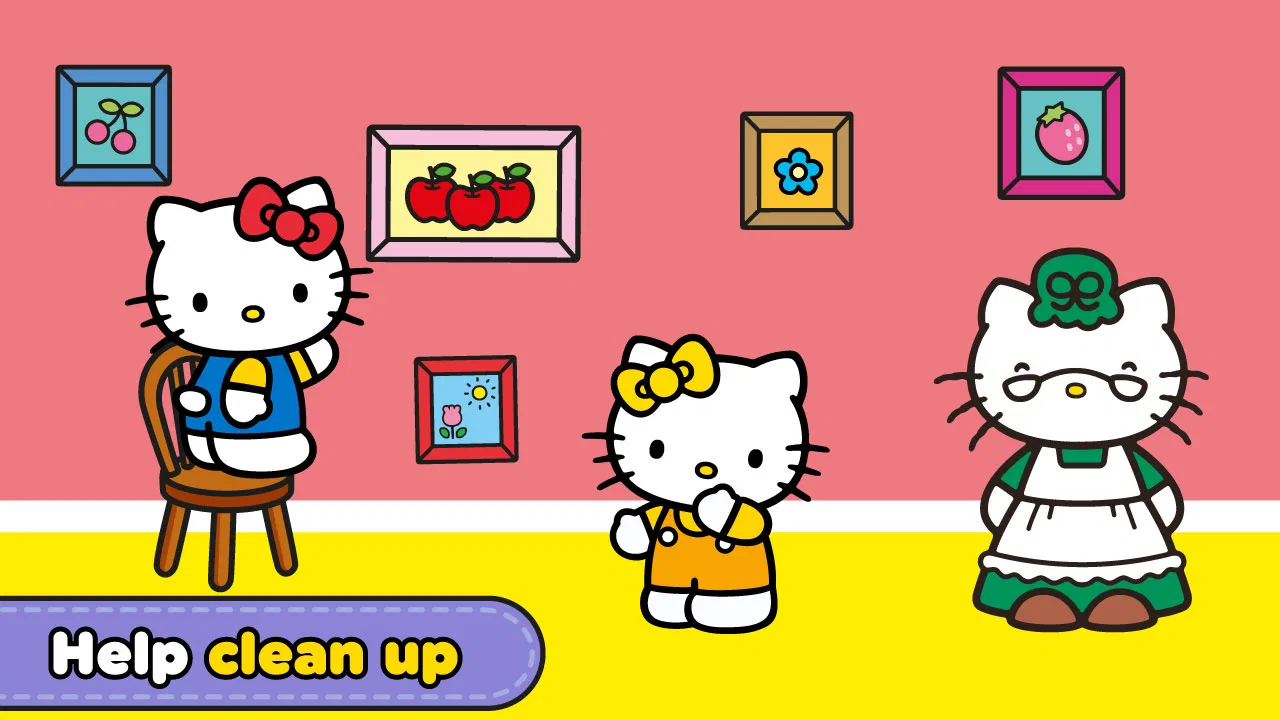
The art direction is the clearest reason the game feels coherent. Hello Kitty's recognizable visual language is naturally suited to a soft, reassuring environment, and the bedtime theme gives the designers a focused emotional palette. Rather than relying on danger or surprise to hold attention, the game uses familiarity and comfort as its main tools.
I like that the setting supports the activity instead of competing with it. In many children's games, bright colors and constant movement can make every screen feel equally urgent. Here, the nighttime context gives the player a reason to slow down. The world feels arranged around preparation, storytelling, and family connection, so the visual presentation reinforces the purpose of the interaction.
This is also where the game differs from a typical preschool learning app. A letter or number game usually treats the screen as a teaching board: identify something, choose an answer, and receive feedback. Hello Kitty: Good Night treats the screen more like a small story space. Its educational value is tied to routine, attention, and participation rather than a lesson plan that parents can easily measure.
That trade-off is important. If you want practice with counting, phonics, memory, or early problem-solving, another app will be more suitable. This title is stronger when the goal is to make bedtime feel familiar and pleasant. I would describe it as educational in a broad, everyday sense, not as a replacement for a structured early-learning curriculum.
Why the character and setting work together
The character choice is not just decoration. Hello Kitty provides a child-sized perspective on bedtime, and that makes ordinary actions easier to approach through imitation. Children often respond well when a familiar character is also preparing for sleep, listening to a story, or spending time with family. The game turns those ideas into a shared fictional moment rather than presenting them as instructions from an adult.
The family element adds another useful layer. Bedtime can sometimes feel like an individual task that a child wants to avoid, but a story involving Hello Kitty and her family presents it as a social experience. That does not guarantee cooperation, of course, yet it gives parents more material for conversation. I can imagine a child comparing the game's bedtime atmosphere with their own home routine, which is exactly the kind of gentle connection this format can encourage.
One non-obvious strength is that the setting gives the player a natural stopping point. A game based on endless levels can make “one more round” difficult to manage. A bedtime-centered activity has a built-in sense of completion: the character is ready for sleep, the story has reached its quiet purpose, and the device can be put aside. Parents should still supervise the session, but the theme itself supports better stopping behavior than many action-focused alternatives.
The limitation is that the same focused setting may reduce replay excitement. Once a child understands the routine, there may be less curiosity than in a game with exploration, collecting, or changing objectives. I would see repeated play as a comfort feature, not as a promise of constant novelty. It is a title to revisit because the mood is familiar, much like rereading a favorite bedtime book.
Sound, rhythm, and the value of not rushing
The sound and pacing are central to whether this game succeeds. A bedtime game can have attractive visuals and still fail if its audio feels busy or its interactions demand quick reactions. My experience is that the title's strongest design choice is its willingness to let the theme breathe. The player is not constantly pushed forward by urgency, and that makes the experience easier to fit into a quiet evening.
Storytelling also changes the rhythm. Instead of treating every interaction as a test, the game uses narrative moments to create pauses between actions. That gives children time to observe and follow along. For younger players, this can be more comfortable than a sequence of timed prompts. For adults, it means the game is less likely to turn bedtime into a contest over speed or performance.
I would not use it as background audio while a child is already in bed, because interactive screen time still keeps attention on the device. Its better role is earlier: sit together, complete the calm activity, listen to the story-oriented parts, and then move directly into the family's offline routine. The game can support a bedtime atmosphere, but it should not replace the final screen-free steps that help a child actually settle.
A practical tip is to lower the device's volume before opening the game and keep the room lighting consistent with the rest of the routine. That sounds minor, but it prevents the app from becoming a sudden change in stimulation. The title's gentle tone works best when the surrounding environment agrees with it. If a child is playing in a bright room after energetic television, the same content may feel less restful.
Where the pacing may not suit a child
Some children need a stronger sense of agency to stay engaged. They may want to make choices, solve a problem, or see an obvious reward after every action. For them, the slower bedtime rhythm could feel empty rather than soothing. I would watch the child's behavior during the first few sessions: if they are tapping randomly, asking when the “real game” begins, or leaving the activity quickly, a more interactive educational title may be a better match.
There is also a difference between calm pacing and passive viewing. Parents should not assume that a story-based game automatically creates meaningful engagement. Ask the child what Hello Kitty is doing, invite them to describe the bedtime steps, and let them connect the story to their own routine. Those small prompts turn the experience into shared play. Without them, the game may become just another video-like distraction.
For families with more than one child, the quiet format can be useful because it does not depend heavily on competition. Siblings can watch and discuss the story together without arguing over scores or turns. On the other hand, children at noticeably different developmental stages may not enjoy it equally. The younger child may appreciate the familiar routine while an older sibling finds the interaction too simple.
How the mechanics fit the bedtime purpose
The mechanics make sense because they serve the theme rather than pulling it in another direction. The player is helping Hello Kitty through a bedtime-focused experience, so the interaction feels connected to the story. That is a better fit than adding unrelated mini-games simply to increase activity. I prefer a small set of actions with a clear emotional purpose over a crowded collection of tasks that would make the title feel like a general activity bundle.
This approach also makes the game accessible to children who are still learning how mobile controls work. The parent can explain the immediate goal in ordinary language, and the child can concentrate on the character and story instead of memorizing a control scheme. Because the content rating is Everyone, it is positioned as a family-friendly choice, though an adult's judgment is still more useful than any label when deciding whether a particular child is ready for independent play.
The main mechanical trade-off is depth. I would not recommend this game to a child looking for a long-term challenge or a system that rewards mastery. Its value is situational: it works when the family wants a short, gentle activity connected to sleep. In that role, simplicity is appropriate. Outside that role, the lack of complexity becomes more noticeable.
Compared with a standard bedtime story app, this game adds interaction and a recognizable character. A child is not only listening; they are participating in Hello Kitty's preparation for sleep. Compared with a typical educational game, it offers less direct academic practice but more emotional context. Compared with a cartoon video, it gives the child something to do and gives the parent opportunities to talk about the routine. Those are meaningful differences, even if the game remains modest in scope.
Managing the free download and optional purchases
The game is free, which lowers the barrier to trying it with a child. It does include optional in-app purchases priced from $1.99 to $9.99 per item. I would check the purchase settings before letting a child explore independently, especially because a young player may not distinguish between an ordinary tap and a paid option. This is less a criticism of the bedtime concept than a reminder that free children's games still require adult oversight around spending.
My preferred workflow is simple: an adult opens the game first, explores the available activity, and decides whether the free portion is enough for the family's needs. Then the child can use it within a clearly agreed routine. If an optional purchase becomes tempting, make that decision away from the bedtime moment rather than turning the end of the session into a negotiation.
The current version is 1.4.6, and the game runs on devices using Android 7.0 or later. That makes compatibility a practical check before installation, particularly if the child uses an older hand-me-down phone or tablet. I would also test the game on the actual device used at night, since screen size, speaker volume, and battery condition can affect whether a calm experience remains convenient.
One of the more useful ways to judge the game is to ask what job you want it to perform. If the job is “give my child a friendly, story-led bedtime activity,” it is well matched. If the job is “teach a specific academic skill,” “occupy a child for a long trip,” or “provide deep replayable gameplay,” I would choose a different category of app. Knowing that before downloading prevents disappointment.
My atmosphere verdict after looking beyond the character
Hello Kitty: Good Night is at its best as a shared wind-down ritual, not as a full-scale game. Its art direction, family setting, story emphasis, and unhurried rhythm point toward the same destination: a softer transition into bedtime. That consistency is more valuable than a long list of mechanics. I came away feeling that the game understands its mood and does not need to pretend to be an action title or a formal learning course.
I would recommend it to parents of young children who already enjoy Hello Kitty, respond to stories, or need a calmer alternative to energetic mobile games. It is especially useful when an adult is willing to sit nearby and turn the activity into conversation. The game can help make bedtime feel less like an abrupt command and more like a familiar sequence shared with a friendly character.
I would be cautious about recommending it to families seeking independent, extended play. The narrow purpose means the experience may become repetitive for children who need constant novelty. It is also not the right substitute for reading a physical book, talking through a child's worries, or maintaining a consistent offline sleep routine. Its role is supportive and transitional.
In the end, I think the title succeeds because its limitations are closely related to its identity. It does not offer the depth of a conventional educational game, but it also avoids turning bedtime into another demanding task. It does not replace a story shared by a parent, but it can give that moment a playful starting point. For a free educational game from Hippo Kids Games with a clear Everyone rating and a strong audience response, that is a sensible and appealing balance.
If your child needs a quiet, character-led activity before sleep, I would give it a try and play the first session together. Keep the routine short, supervise optional purchases, and treat the game as one step in winding down rather than the final thing a child sees before sleeping. Used that way, its setting and pacing make much more sense, and its gentle atmosphere becomes the feature that separates it from louder, busier alternatives.
FAQs for Hello Kitty: Good Night
01What is Hello Kitty: Good Night?
Hello Kitty: Good Night is a relaxing, family-friendly mobile experience designed around bedtime routines and gentle nighttime activities. It features Hello Kitty and her friends in a colorful, comforting setting, making it suitable for younger children who enjoy simple interactions, calming visuals, and familiar characters. The exact activities and available content may vary depending on the version and device.
02Is Hello Kitty: Good Night suitable for children?
The app is generally aimed at young children and families, with an easy-to-understand presentation and soft, playful themes. Parents should still check the recommended age rating shown on Google Play or the App Store before downloading. It is also a good idea to explore the app together initially, especially to review advertisements, in-app purchases, permissions, and any external links that may be included.
03Does Hello Kitty: Good Night require an internet connection?
Some parts of Hello Kitty: Good Night may work without a constant internet connection after installation, which can be convenient during travel or at bedtime. However, internet access may be needed for the first download, updates, advertisements, account-related features, or additional content. Because offline availability can differ between versions, users should confirm the current store description and test the app after installation.
04Is Hello Kitty: Good Night free to download?
Hello Kitty: Good Night may be available as a free download, but the presence of advertisements, optional purchases, or paid content depends on the version offered in your region. Before installing, review the app-store listing for pricing details and payment information. Parents should also use device-level purchase restrictions if children will be using the app without supervision.
05Can Hello Kitty: Good Night be used as a real bedtime aid?
The app can provide a pleasant, calming activity before sleep, especially for children who enjoy Hello Kitty and gentle nighttime themes. Nevertheless, it should not replace a consistent bedtime routine, reading time, or advice from a healthcare professional. Screen brightness, sound, and stimulation should be kept low, and families may prefer ending app use several minutes before bedtime to encourage a smoother transition to sleep.
Pros
- Gentle bedtime activities are suitable for young children.
- Simple controls make the app easy for little users to navigate.
- Hello Kitty characters create a familiar
- comforting atmosphere.
- Soft visuals and animations support a relaxing nighttime routine.
- Works well as a short
- calming activity before sleep.
Cons
- Some content may feel repetitive after frequent use.
- Limited interaction may not keep older children engaged.
- Parents may want more customization for bedtime routines.
- In-app audio could be unsuitable in shared or quiet spaces.
- Availability of features may vary by device or platform.

Hello Kitty: Good Night
Gallery